In Perfect Circle you draw a circle around a dot, in one stroke, with your finger or mouse. You get a score like 92.0%. People always ask the same thing: 92% of what?
 A circle being drawn. Green bits are on track; yellow bits bulge out or dip in.
What "round" means here
A perfect circle is the same distance from its centre all the way round. So the game measures, for every point of your line, how far it is from the dot. Then it looks at how much those distances vary.
- If every point is exactly the same distance from the dot, there's no variation, and you score 100%.
- The more the distance wobbles, the lower the score.
In numbers: the game takes the spread of those distances (the standard deviation) and divides it by their average. Your score is 100 × (1 − 3 × that spread), kept between 0 and 100. A line whose distance from the dot varies by about 2.7% on average scores around 92%.
The centre is the dot, not the middle of whatever you drew. So a perfectly round circle that's off to one side scores badly. That's on purpose: the task is a circle around the dot.
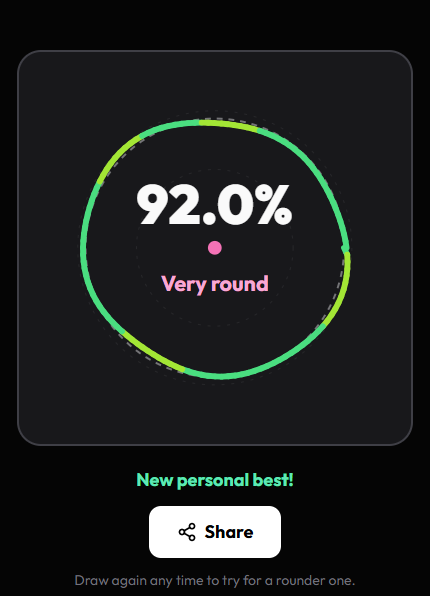 After you finish, a dashed circle shows the ideal one at your average size, so you can see where yours went off.
Why ovals score low
An oval is close to a circle on the top and bottom, but far from it on the sides. When we tested the scoring, a 4:3 oval (a third wider than it is tall) scored about 70%. That's the same score as a circle with a lot of wobble in it.
The words under the score are bands: 97% and up is "Nearly perfect", 92% "Very round", 85% "Pretty round", 70% "A bit wobbly", and anything lower is "More of a potato".
The rules that stop a score
You don't always get a number. The game tells you why instead:
- "Too small." Circles have to be big enough to judge. Tiny wobbles look huge on a tiny circle.
- "Go around the dot, not through it." If the line comes very close to the dot, it isn't going around it.
- "Keep going!" If you let go before you've gone almost all the way round (330°), it doesn't count yet.
Once your line has gone a full turn, the circle finishes by itself. You don't have to let go at the exact spot you started. Clockwise and anticlockwise both work.
How to draw a rounder one
- Go bigger. The same small wobble costs less on a big circle.
- Keep a steady speed. Most circles go flat where people slow down, usually near the end.
- Watch the dot, not your finger. It's easier to keep an even distance from something you're looking at.
- On a phone, draw with your whole arm rather than just your thumb.
Your best score is kept on your device. Share it and see if anyone can beat it.