Reaction Time is the simplest game on the site. A box turns red. After a while it turns green. You tap. That's it. But there's a bit more going on behind the number you get, and knowing it helps you read your score properly.
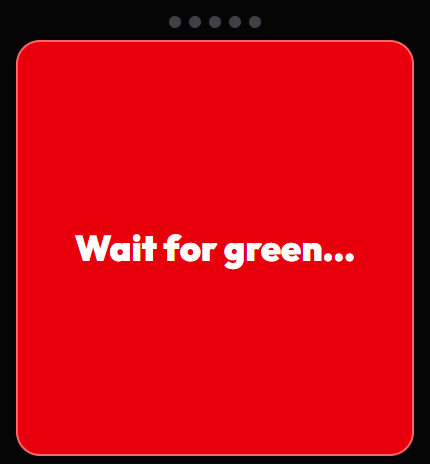 Red means wait. The wait is random, so you can't learn the timing.
How a round works
- You tap the box to start. It turns red.
- After a random wait of 1.5 to 4 seconds, it turns green.
- You tap as fast as you can. That round's time appears in big numbers.
- You play five rounds, and your score is the average of the five.
Tapping while it's still red shows "Too soon!" right where your finger landed, and that round just starts again. It doesn't count against you. A tap that comes less than 100 ms after green also counts as too soon, because that's a guess that happened to land late, not a reaction.
 One round, recorded in the game: wait, green, tap, and the time.
What the score means
The game measures the time between green appearing on the screen and your tap reaching the page. That's your eyes, your brain and your hand, plus your device:
- A 60 Hz screen redraws every 16.7 ms, so green can show up a little after the page asked for it. The game starts its clock on the frame that paints green, not when it decided to turn green, to keep this small.
- Touch screens, wireless mice and Bluetooth keyboards each add a delay of their own.
So the same person can score differently on a phone and a laptop. Compare scores made on the same device.
The labels are simple fixed bands, not a ranking against other players: under 200 ms is "Lightning fast", under 250 ms "Quick", under 300 ms "Steady", under 400 ms "Relaxed". We don't show "faster than X% of people" because we don't collect anyone's scores.
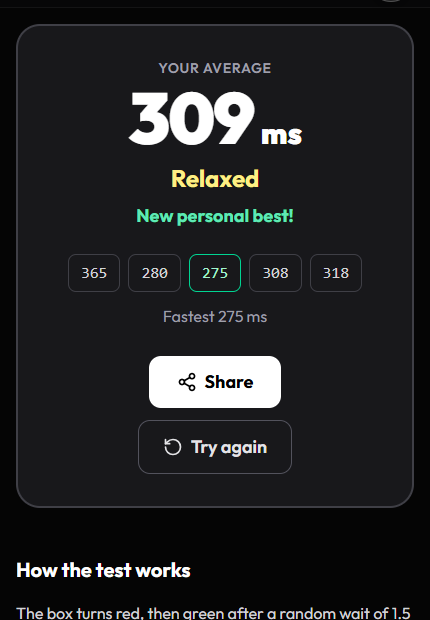 The result: your average, the five rounds (the fastest is outlined), and your best on this device.
When you share your result, each round becomes a coloured square: green under 250 ms, yellow under 400 ms, red above that.
How to get faster (honestly)
- Rest your finger on the screen or mouse button before green. Then it only has to press, not travel.
- Look at the middle of the box, not at your finger.
- Don't guess. The wait is random, so guesses mostly end in "Too soon!".
- Tired, distracted or cold hands make everyone slower. If your score is off, try again after a break.
If you switch tabs in the middle of a round, the round is cancelled. A time measured while the page was hidden wouldn't mean anything.
A second test: Stop at 10.00
Stop at 10.00 tests a different sense of timing. You start a stopwatch and try to stop it at exactly 10 seconds. The catch: the clock fades out after 3 seconds, so the last 7 are in your head.
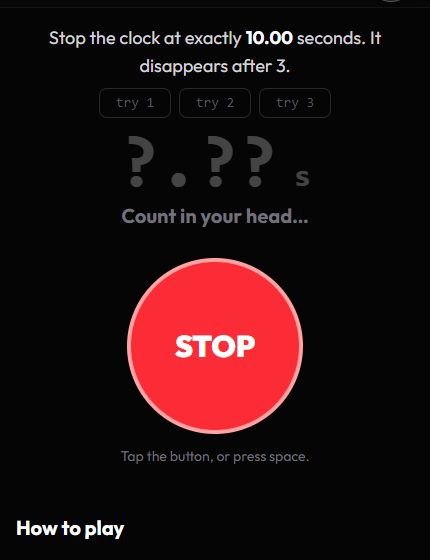 After 3 seconds the clock fades to ?.?? and you're on your own.
You get three tries, and your closest one counts. Within 0.05 seconds is a perfect stop; within 0.3 seconds gets a "Close!".
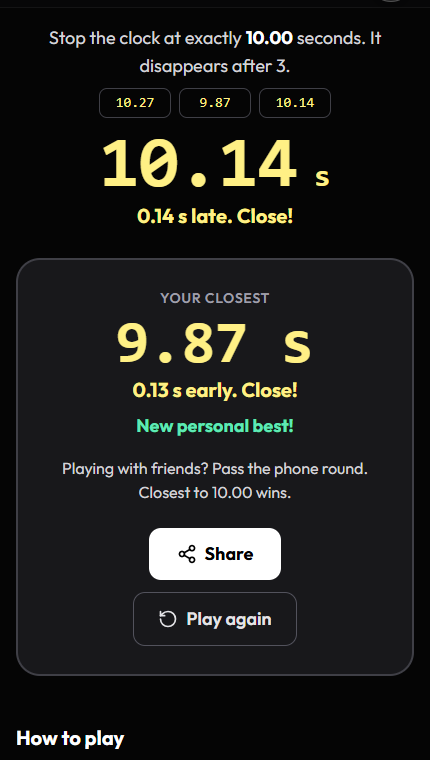 Three tries. The closest counts, and your best is kept on this device.
It works best passed round a group: everyone gets three tries, and whoever ends up closest to 10.00 wins.