In Pixel Flood you own one square in the top-left corner. Each move, you pick a colour. Your patch turns that colour and swallows every touching square of the same colour. Keep going until the whole board is yours.
The catch is the move limit. Medium is a 14×14 board with 30 moves. Hard is 18×18 with 40. If you just tap whatever colour grabs the most right now, you'll often finish with a few stubborn squares left and no moves to take them.
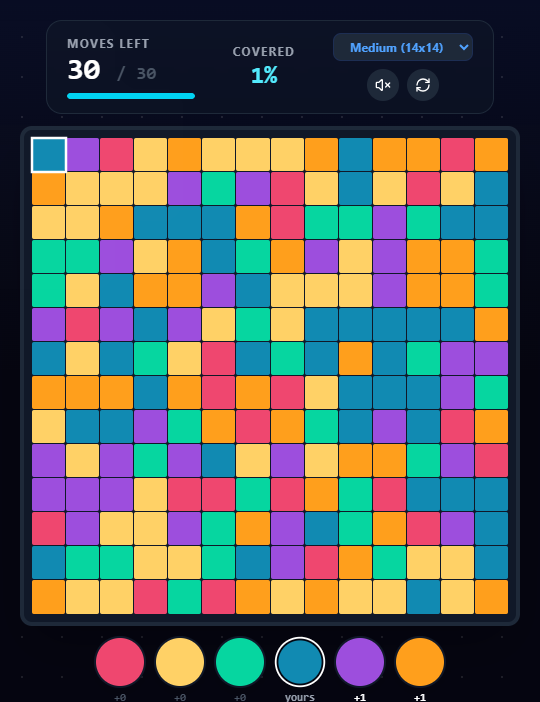 A fresh Medium board. Your patch is the outlined square, top-left. The number under each colour is how many squares it would add right now.
Read the numbers under the buttons
Each colour button shows a small +N. That's how many squares you'd gain by picking it now. It's the quickest way to see your options, and early on the biggest number is usually a good pick.
But it only tells you about this one move. The next three tips are about what happens after it.
 Five moves on Medium, each time picking the biggest +N. Watch where the patch grows: mostly along the top and left edges.
1. Head for the far corner
The bottom-right corner is the part of the board that's hardest to reach. Squares there only get absorbed once your patch has crossed the whole board to them.
So when two colours are close in +N, pick the one that pushes your edge toward the bottom-right, not the one that fattens the area you already have. A patch that stretches diagonally across the board touches far more squares than a round blob of the same size.
2. Look one colour behind
Before you pick a colour, look at what's behind the squares you'd grab.
Say blue gives you +6, but those six squares are surrounded by pink and your next pink move would only add 2. Meanwhile green gives +4 and opens onto a big yellow patch. Green is the better move, even though its number is smaller. You're choosing the next two moves, not one.
3. Spend one move to reach a big patch
Sometimes the best move grabs almost nothing. If a single thin line of one colour separates you from a large block of another, take the line first. You'll "waste" a move on +2, then collect +15 on the next.
A rough rule we use: if a small move connects you to eight or more squares of one colour, it's worth it.
4. Clean up as you go
Near the end, what costs moves is single squares of a colour you've stopped picking, left behind in corners. If you notice one next to your edge, pick up its colour when that move also gains something elsewhere. Clearing it later costs a whole move on its own.
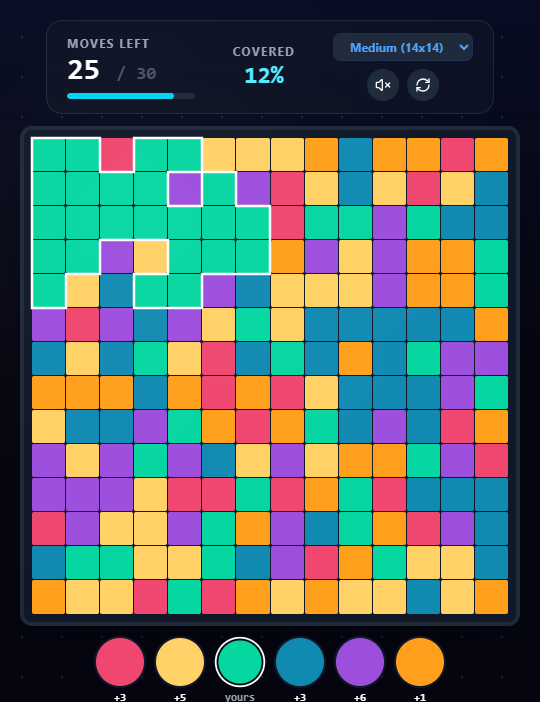 Five moves in: 6% covered, 25 moves left. The edge now runs along both sides, so the next picks can grow in two directions at once.
How many moves is "good"?
On Medium, finishing with a few moves spare is a solid game. The stars on the result screen are based on how many moves you had left, so a clean finish on Easy is a good way to practise before moving up. If you run out, the result card shows how much of the board you covered. Aim to beat that number next time, not just to win.
Ready? Play Pixel Flood. If you want to know why "grab the most" isn't always best, Can You Beat an Algorithm at Its Own Game? explains the maths behind it.