Open a board game box like Catan, or start a strategy game like Civilization V, and you'll often find the map is made of hexagons. Our game Hex Dominion is too. It isn't only for looks. Hexagons fix a real problem that square grids have.
The problem with squares
On a square grid, each square has 4 neighbours it shares an edge with, and 4 more it only touches at a corner.
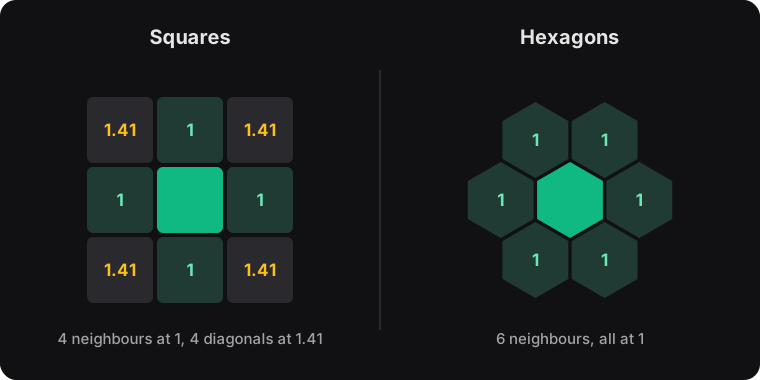 Centre to centre, a square's diagonal neighbours are about 1.41 times as far away as its edge neighbours. Every hexagon neighbour is the same distance.
Measure from centre to centre and the diagonal neighbours are farther away: about 1.41 times (that's √2, from Pythagoras). So game designers have to pick a rule, and every choice has a downside:
- Diagonal moves allowed, same cost: moving diagonally covers more ground for free, so zig-zagging becomes the fastest way to travel. Distances feel wrong.
- Diagonal moves banned: units move in stiff L-shapes, and "next to" is ambiguous. Does a corner-touching square count?
- Diagonal moves cost more (1.5 or 2): more accurate, but now everyone has to do arithmetic to plan a move.
Hexagons have one kind of neighbour
A hexagon has 6 neighbours, and every one shares a full edge and sits at exactly the same distance. There's no diagonal, so the question never comes up. "Adjacent" means one thing. Counting steps across the map gives an honest distance. Paths look smooth and natural instead of blocky.
That's why wargames have used hex maps for decades: the terrain behaves more like real ground.
What that means in Hex Dominion
Six neighbours changes how the game plays:
- A hex can be attacked from up to six sides. A single strong hex sticking out of your territory is exposed on several faces. A compact block protects most edges.
- Front lines are clearer. Every border hex touches the enemy along whole edges, so you can see exactly which hexes need fortifying.
- There are no "corner" tricks. You can't slip diagonally between two enemy hexes, because there's no diagonal to slip through.
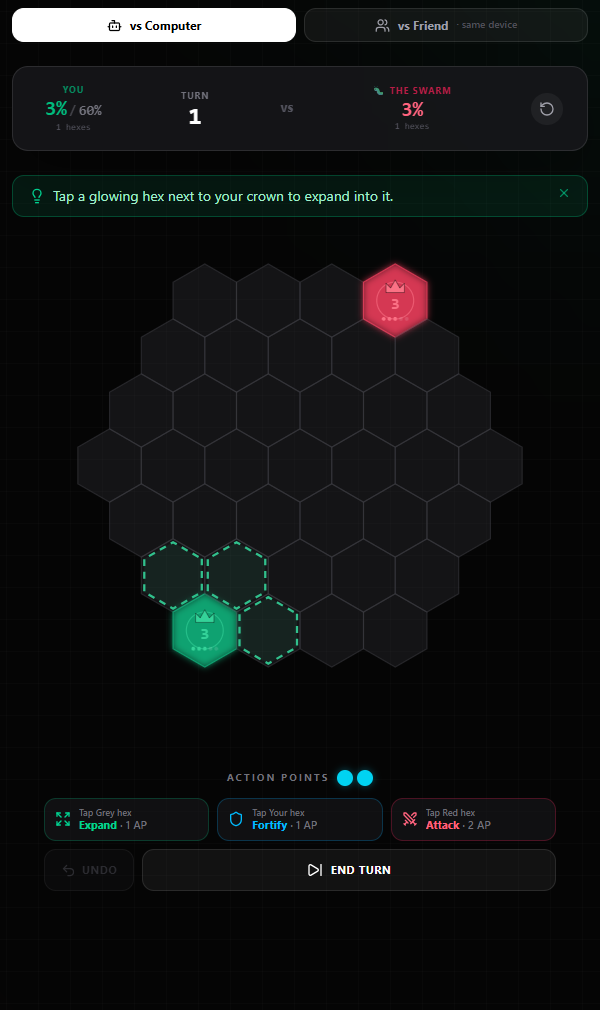 The Settler map in Hex Dominion. Each hex borders six others. The dashed ones are where you can expand this turn.
Hexagons in nature
Bees build honeycomb from hexagons for a related reason. Of the shapes that tile a flat surface with no gaps, the regular hexagon encloses a given area with the least wall. Mathematicians long suspected this, and Thomas Hales proved it in 1999 (the "honeycomb conjecture"). Less wall means less wax for the bees and, in games, a shape that packs neatly.
Next time you play Hex Dominion, count the neighbours of your crown before you pick where to grow. There are six, and every one is a way in.