First, the honest part, because most "brain training" lists skip it.
In 2016 a group of psychologists reviewed the evidence behind brain-training products (Simons and colleagues, 2016). Their conclusion, roughly: practising a task makes you better at that task, and at very similar ones. There was little good evidence that it makes you sharper in general, at work, or in daily life.
So we won't promise that these games will raise your IQ. What they do is give you focused practice at specific kinds of thinking, in a form that's fun enough to come back to. That's worth something. Here are five, and what each one actually exercises.
1. Brain Sprint: switching fast
Practises: speed, attention, switching between tasks · Play
Sixty seconds, five different mini-challenges in a row: a quick true-or-false sum, a colour-word test, a number pattern, a grid of tiles to memorise, and a reaction test. Wrong answers cost you 5 seconds, so guessing doesn't pay.
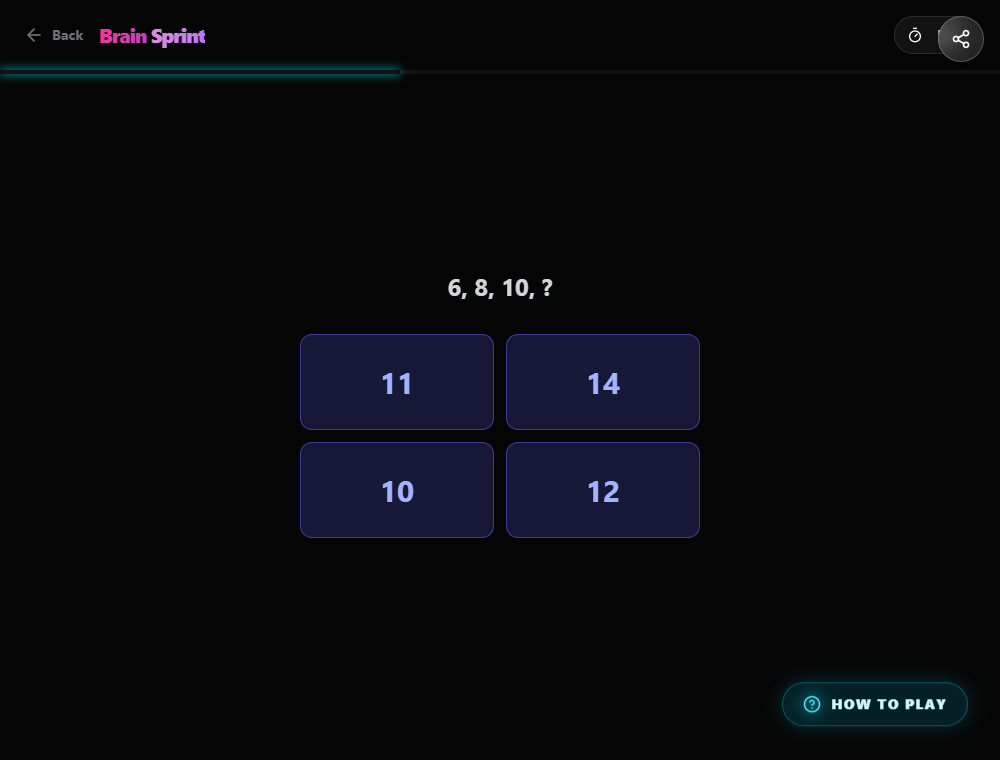 The pattern round: what comes next in 6, 8, 10?
The colour-word round is a version of the Stroop test, one of psychology's oldest experiments. The word BLUE might be printed in blue or in red, and you answer whether the colour matches the meaning. Reading is so automatic that ignoring the word takes real effort, and you can feel it.
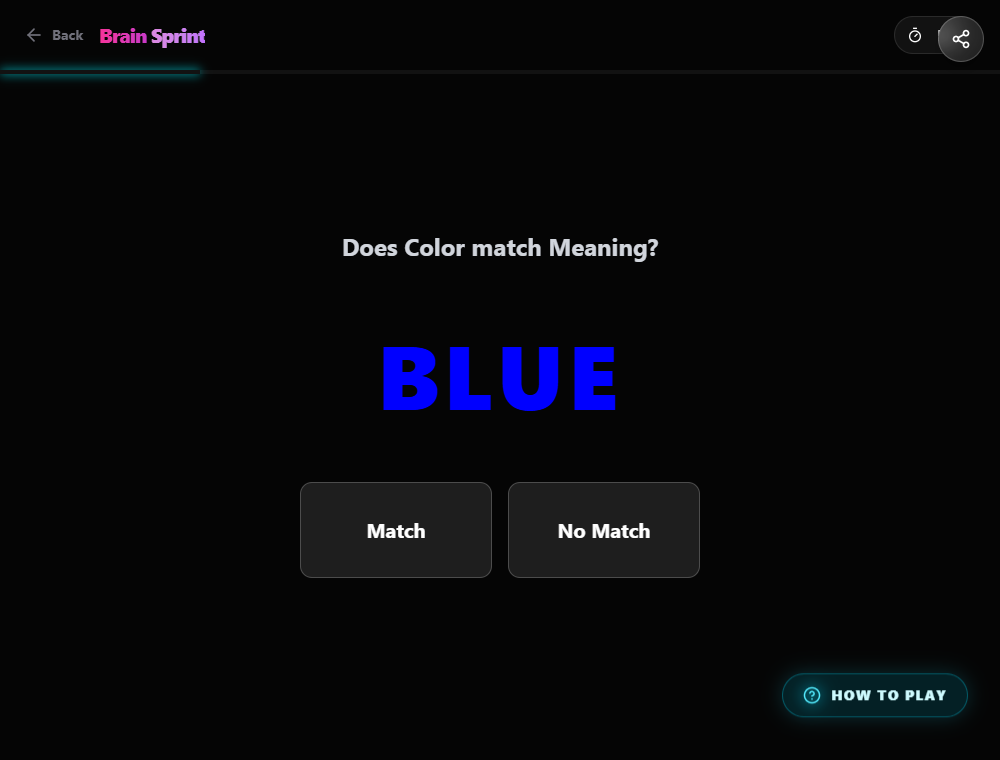 The colour-word round. Easy when they match. Try it when they don't.
2. Pixel Flood: planning ahead
Practises: planning, weighing now against later · Play
Turn the whole board one colour in a fixed number of moves. The move that grabs the most squares now is often not the move that wins, so you learn to look one or two steps ahead. We wrote a whole guide: How to Beat Pixel Flood With Moves to Spare.
3. Logic Gates: step-by-step reasoning
Practises: logical reasoning, working backwards · Play
Pick the right gate (AND, OR, NOT, XOR and more) so the circuit produces the output it asks for. Early levels are one choice. Later ones chain several gates, and the reliable method is to reason backwards from the output. New to gates? Start with A Beginner's Guide to Logic Gates.
4. Excel Ninja: a skill that transfers because it's real
Practises: real keyboard shortcuts you'll use at work · Play
This one gets around the research problem above. Excel Ninja teaches actual Excel shortcuts on a practice sheet: copy, paste, bold, currency format, select a column. Then it tests them from memory. The "transfer" is easy because what you practise is the real skill. Press Ctrl + Shift + $ in the game and it does the same thing at work tomorrow. Our guide The Excel Shortcuts Worth Learning First lists which ones to start with.
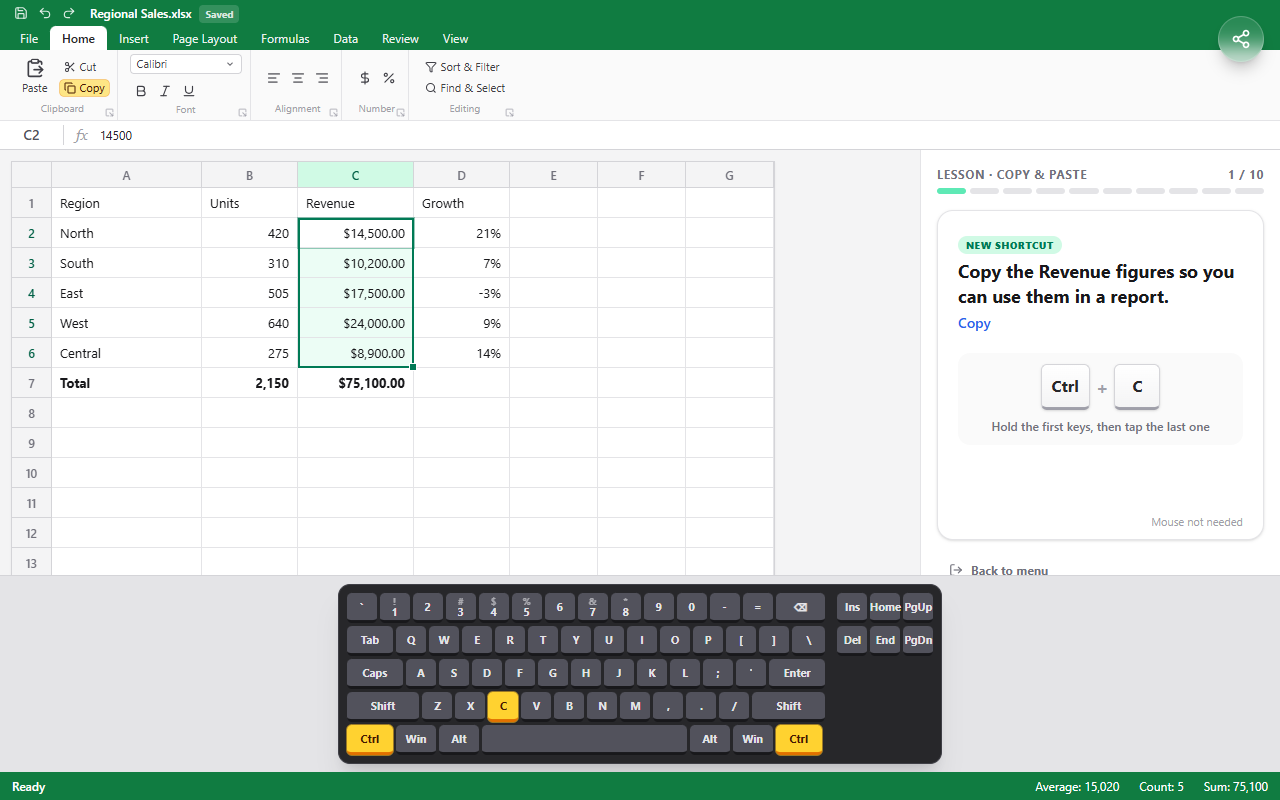 An Excel Ninja lesson. New shortcuts are shown first, then asked for again from memory.
5. Sudoku: sustained concentration
Practises: patience, keeping several possibilities in mind · free on many sites
Not ours, but it belongs on any list like this. Sudoku asks you to hold a chain of "if this is a 4, then that must be a 7" in your head and follow it through without slipping. It rewards slow, careful thinking, which is a nice contrast to Brain Sprint.
Getting the most out of it
If you want these games to do more than pass the time:
- Pick the skill, then the game. Want to be quicker with spreadsheets? Excel Ninja beats any general brain game.
- Play at the edge of your ability. When a level feels easy, move up. Practice only helps when it's a bit hard.
- Short and regular beats long and rare. Five minutes a day is plenty.
- Keep the other things that are known to help: sleep, exercise and time with people have much stronger evidence for keeping your mind in good shape than any app.
Then enjoy the games for what they are: good puzzles.